
Hedge Funds, Venture Capital and Writing with Sebastian Mallaby
The author of More Money Than God and The Power Law

I recently exchanged ideas with one of my favourite writers, Sebastian Mallaby. He is the author of More Money Than God, a brilliant book about hedge funds (a page turner and one of my favourite books), and The Power Law, another superb book about venture capital. His next book is about Google DeepMind — read on to find out!
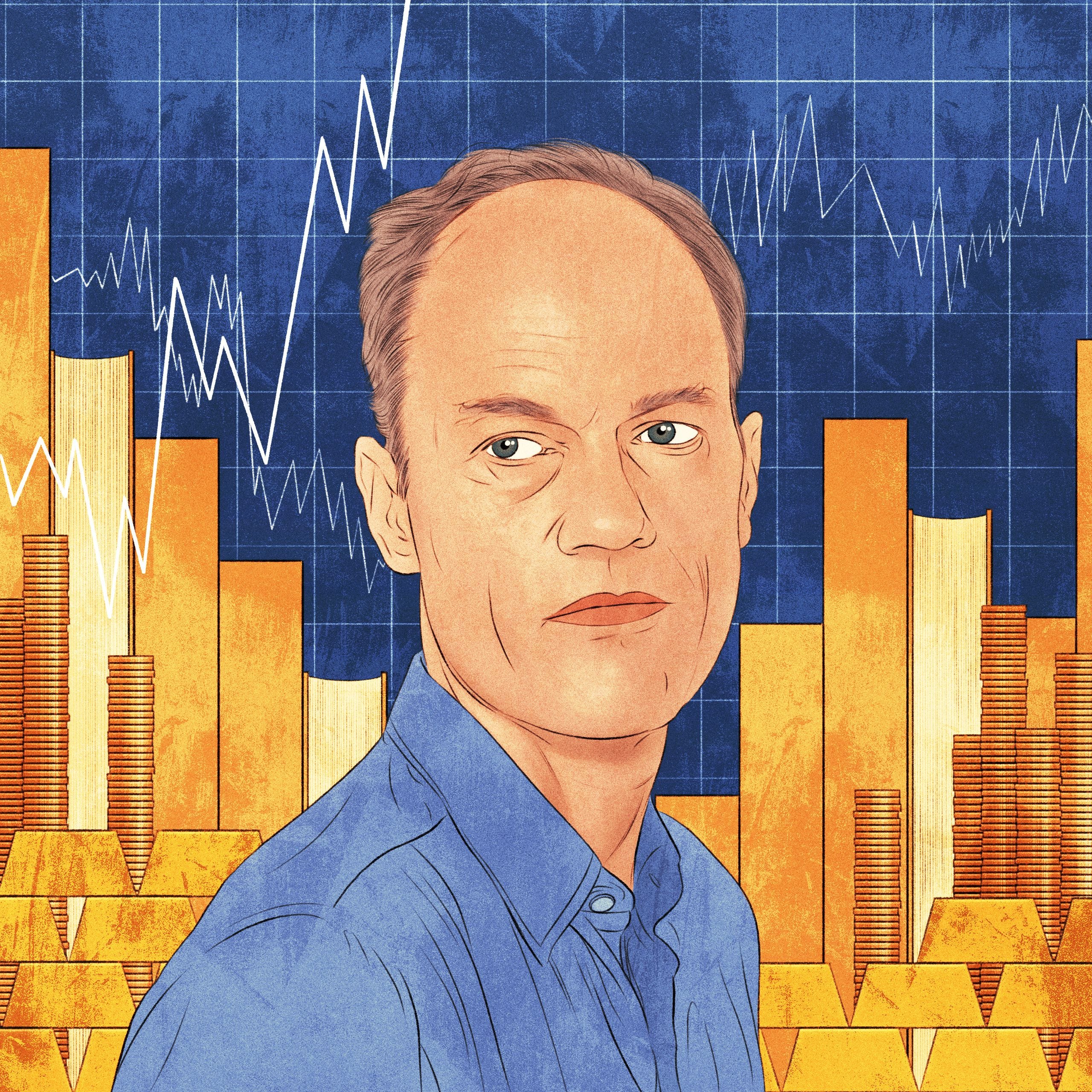
MM: You graduated with a First Class degree in modern history from Oxford — what was that experience like? What were your favourite classes, favourite professors, favourite tutorials?
SM: Oxford gave students a broad choice in what they focused on. My concentration was British and European history from around the mid 1850s to 1939. Of course, the main political drama in that period was the contest between socialism, democratic capitalism, and fascism. I became fascinated by the question of why the left was a big factor in France, Germany, Italy, Spain and obviously Russia. But Britain had no Marxist movement to speak of. The reason lay in the malleability of the British establishment. By gradually extending the franchise and offering some measure of economic inclusion, Britain turned the revolutionary left into the pragmatic, labor union left. Pragmatism bred pragmatism, in other words. It’s a lesson we might recall today in these polarized times.
MM: From my observations it seems like the species of macro hedge funds (once thriving with George Soros, Jim Rogers, Paul Tudor Jones etc.) has gone extinct or at least endangered in recent times. For example, Peter Thiel’s Clarium Capital suffered losses post 2008 and was shut down; Ray Dalio’s Bridgewater has underperformed the S&P. Why do you think this happened? Can it be revived — if so, how?
SM: Macro hedge funds grew up in response to the end of the dollar-gold peg in 1971, which caused currency fluctuations that could be traded. Macro trading then entered its prime in the 1990s, when governments tried to tame currency volatility by soft-pegging their currencies. The soft pegs set up easy targets for hedge funds, which could sell so much of a weak currency that the pegs would eventually break, handing the traders a fortune. Breaking a soft peg was how Soros and other macro traders profited from the devaluation of the British pound in 1992, and versions on the same drama played out in Asia later in the decade. These days macro trading is somewhat subdued, because there are fewer ill-considered currency pegs to target. Most currencies float, and the ones that don’t (e.g., in East Asia) are generally being artificially held down rather than being propped up. When a currency is being held down, it does not present a target for speculators because the government can always print and sell more of its own currency to keep it down. This is the main reason that macro funds are less successful these days, though there are still opportunities to trade currencies, interest rates and so forth.
MM: What do you think about the species of philosopher-investors? George Soros comes to mind for his theory of reflexivity. Similarly, Peter Thiel for his synthesis of Girardian and Straussian ideas into his investing. How do such people operate? Is their philosophy an attempt to intellectualize or is it deeply intertwined with their investing? And what do you think about being a philosopher-investor in the age of AI?
SM: Hedge fund investing is a highly intellectual pursuit, so not surprisingly many practitioners are also interested in philosophy. In the special case of George Soros, the theory of reflexivity opened his mind to the boom-bust nature of financial markets: reflexivity’s insight is that opinions of what will happen can be self-fulfilling, and that the feedback loop between belief and reality can drive a market so far from fair value that it will eventually reverse violently. But in general I would doubt that the philosophy of hedge fund investors has a lot to do with how they actually trade.
MM: Renaissance Technologies hires the best and brightest PhDs in physics, math, astrophysics and computer science. Evidently, they have done extremely well at generating returns as a quant hedge fund — but what do you think about the societal cost of redirecting top scientific talent into finance (“brain drain”)?
SM: The diversion of scientific talent into quant trading often raises concerns, but I don’t think there is a strong case for worrying. I say this for six reasons.
First, the hundred or so PhDs at Renaissance Technologies are extremely smart, but one hundred is a tiny number relative to the number of PhDs employed at a tech company. For example, Alphabet is thought to employ several thousand PhDs.
Second, the hundred-strong team at Renaissance Technologies is eliminating inefficiencies in a very broad range of financial instruments—currencies, stocks, commodities—and they are doing this globally. So the world is getting a lot of additional efficiency from a relatively small number of quants. This efficiency ensures that average retail investors can sell their positions any time without worrying that they are selling at a bad moment when some sort of liquidity distortion or other temporary dislocation will cause them to be ripped off. It’s hard to quantify the social benefit of this financial efficiency, but it’s non-zero. We don’t really know whether those same hundred PhDs would have contributed more to society by staying in academia or going into other industries. But we can’t be sure that their contribution would be greater.
Third, the discussion of where or how quants contribute most assumes that there is a fixed number of quants. But the rise of quantitative trading creates an incentive for young students to get a quantitative training. The success of Renaissance Technologies has probably increased the supply of Americans doing graduate degrees in fields such as math, computer science, or physics. So, a bit like the famous “lump of labor” fallacy in economics, there is a “lump of quant” fallacy in this debate.
Fourth, Jim Simons, the founder of Renaissance Technologies, created various philanthropic initiatives to fund math education and scientific research. When my daughter did an astrophysics PhD at UChicago, the Simons Foundation was funding a lot of the activity in her field. (She had no idea that this Simons was the same person as the founder of the hedge fund that I had written about.) Likewise, DE Shaw, founder of the eponymous quant hedge fund, also created DE Shaw Research, creating research jobs for several dozen PhD scientists. A Shaw Research alum, John Jumper, won the Nobel Prize in 2024.
Fifth, free societies should allow quants to choose for themselves where they want to work. If we start second-guessing their choices, we could second-guess a lot of other ones. Should we allow people to work in the fashion industry, which labors to extract large sums of money from clothing whose functional value is indistinguishable from cheaper clothing? Isn’t the fashion industry stoking envy and insecurity? Shouldn’t we require smart business leaders to work in other fields? (Obviously not!)
Finally, and more generally, it’s often argued that the growth of employment in the financial sector is a disturbing trend. Do we really need all these spreadsheet jockeys? But as economies become more technically specialized and complex, it’s reasonable for the financial sector to grow, because the role of finance is to allocate capital wisely to all these technical and specialized industries. We know from experience that central planning is a bad way to make these allocation decisions. So we need a sophisticated financial system to do it.
MM: With the proliferation of VC funds, it seems like capital is becoming a commodity. What really differentiates one VC shop versus another? Is it track record? Value added to investee companies? What are some examples of real differentiation?
SM: Track record certainly helps. Most founders would be happy to take money from one of the top funds because the brand is valuable: saying “I’m doing a startup” will elicit a shrug, but saying “I’m doing a startup backed by Sequoia” confers instant credibility. But VC partnerships also get into deals because a particular partner has a good reputation. A strong VC partner may add value to a startup by bringing engineering judgment, hiring experience, go-to-market skills, introductions to potential customers, a network in another country, or even just emotional solidarity and counselling. Also, there are many stories in venture about startups that get turned down by famous VCs, eventually take money from a non-famous one, and then do well—PayPal was initially backed by Nokia Ventures for example. So it’s not just deal access that matters in venture. Deal selection is another differentiator.
MM: From Napoleon Ta of Founders Fund to the team at Renaissance Technologies, some of the best investors prefer to stay under the radar. When you start a new book, what exactly helps you get access — emails sent, mutual friends tapped, documents requested? A concrete walk‑through would be invaluable to aspiring long‑form writers.
SM: It’s all of the above. You have to try everything and eventually you may get access. Expect to have the door slammed in your face a few times. But in general it’s a combination of getting to know people who know other people who then eventually intro you to the people you need to interview, and being very well prepared at each step of the way. Don’t expect people to spend time with you if you haven’t studied all that’s public about them already. When I go see someone, I often have ten pages of typed questions that I’ve worked on for days. If I’ve put in the time, the interviewee is more likely to put in the time. If I can complete their sentences for them because they are repeating a point they have already made on a podcast, this will encourage them to dig deeper and say something surprising that they have not aired with any other writer.
MM: What are the most fascinating use cases of AI in investing that you have seen, across all stages from VC to public markets?
SM: I actually think that being a venture capitalist is one of the jobs that is least likely to be disrupted by AI. Being a VC is about bonding with human founders. It is about judging whether a brand-new product idea will be of interest to human customers. It is about imagining the future—and the future is not in an AI’s training set. On the other hand, there are other types of investing that have been using AI for quite a while—algorithmic market making and so forth. Between these two poles, there are funds that haven’t historically used AI but that are now starting to do so. I hear of lots of use cases: for example, a merger-arb hedge fund that can ask an LLM for help analyzing how an anti-trust review is likely to come out.
MM: What are 3 books you would love to read that nobody has written? What are 3 books you most highly recommend reading?
SM: I’m fascinated about how, in common law systems, private lawyers can invent novel legal structures that change the way that capitalism functions; and yet they are anonymous, have no democratic mandate, and most people don’t even realize that the rules are created this way. So I think a great book on the industry of commercial law would be worthwhile. It’s grown like crazy in New York and London. It’s powerful. It’s secretive. What more do you want? (It would be a huge task to gain access!)
Good books to read: I loved The Money Game by Adam Smith, an old classic about the market frenzy of the 1960s. I also thought Too Big To Fail by Andrew Sorkin, a fly-on-the-wall account of the 2008 financial crash, was wonderful. I am looking forward to reading Sorkin’s new book on the 1929 crash.
MM: What book are you working on next?
SM: By luck, I negotiated deep access to DeepMind, the Google AI lab, in November 2022—the same month that ChatGPT turned AI into a cultural obsession. Since then, I’ve interviewed around a hundred AI scientists inside and outside the lab, and spent more than thirty hours with Demis Hassabis, DeepMind’s principal founder. Hassabis is an extraordinary character, and AI raises profound questions about the nature of human cognition, the future of human society, and the dilemma of the scientist who creates a potentially existential technology—what I think of as the “Oppenheimer conundrum.” Friends who have read early drafts of the manuscript tell me this is my best book so far—but then those are my friends! The book will be out in 2026.